Learn the prerequisite
Train base20k for 20k steps on 100 blue-square demonstrations of direct corner grasping.
1 East China University of Science and Technology
Advisor: Ning Guo (郭宁)2
2 School of Artificial Intelligence, Shanghai Jiao Tong University
Summer research project · HIROL Lab
A staged learning pipeline for precise corner grasping and complete towel folding on two Piper arms. The final policy succeeds in 35 of 50 trials across five towels placed at random positions.
static/videos/finetune10k.mp4
A complete autonomous fold by the fine-tuned policy. The towel is placed at a random test position.
Overview
Precise cloth manipulation is difficult to learn from a small set of successful demonstrations: a policy may approach the cloth while still missing the corners required for a stable bimanual grasp. We study a staged alternative. An ACT policy is first trained on 100 direct corner-grasp demonstrations using a blue square towel. The policy is then deployed, and a human operator takes over at states where the grippers are misaligned or likely to miss. These interventions produce 101 full-task trajectories on red and green towels. Fine-tuning from the corner-grasp checkpoint reaches 70% full-task success over 50 random-placement trials, compared with 26% for the pretrained policy and 20% for a policy trained from scratch on the HIL data. The results support corrective HIL fine-tuning as a practical route for this system, while leaving position-controlled robustness and cross-instance generalization open.
System
physical_ai_runtime connects the cameras, policy, RMI authority layer, dual-arm control and episode recorder. The same runtime is used for autonomous evaluation and for switching to leader-arm control during HIL collection.
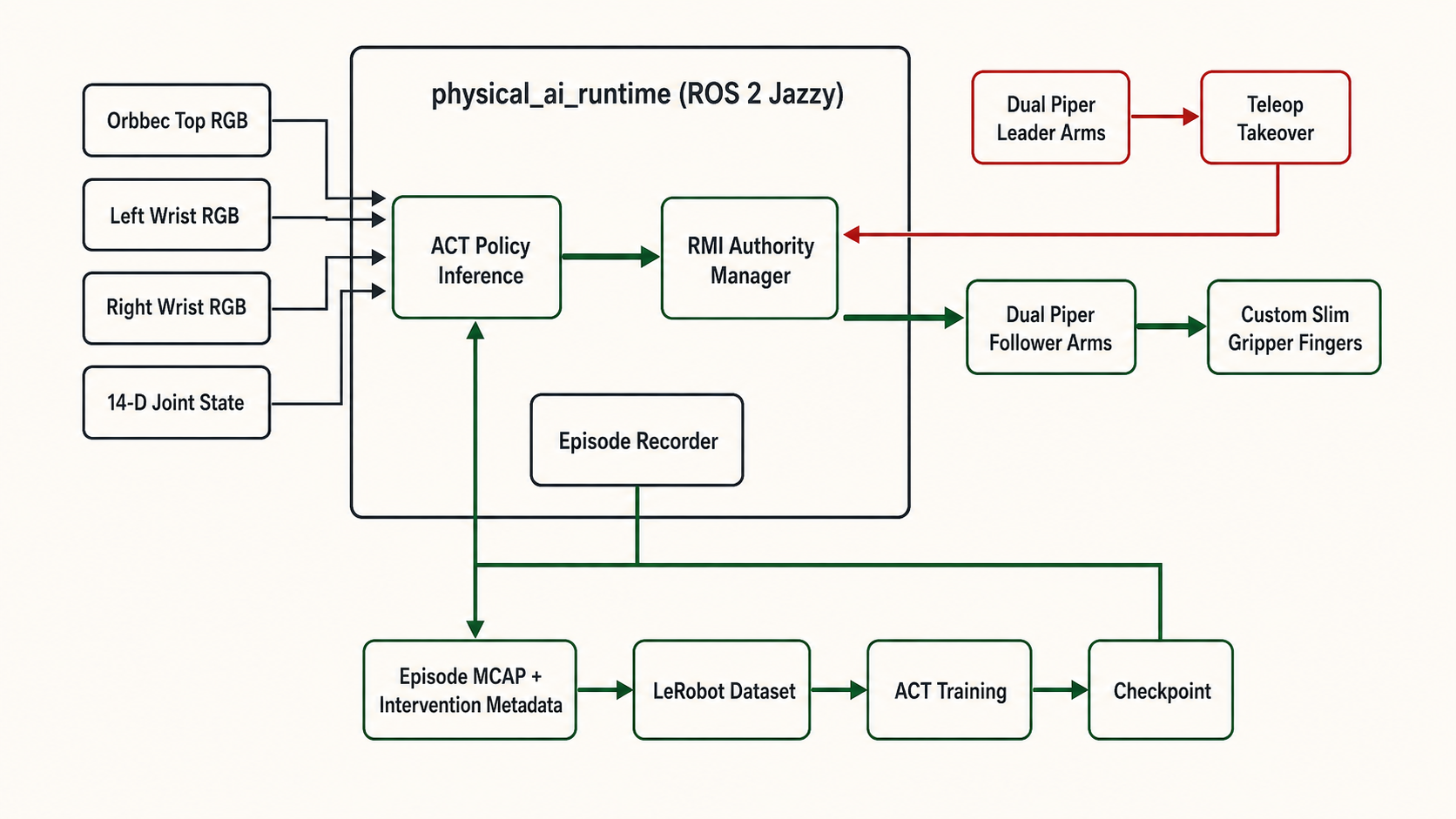
static/images/runtime_architecture.pngstatic/videos/three_camera_inputs.mp4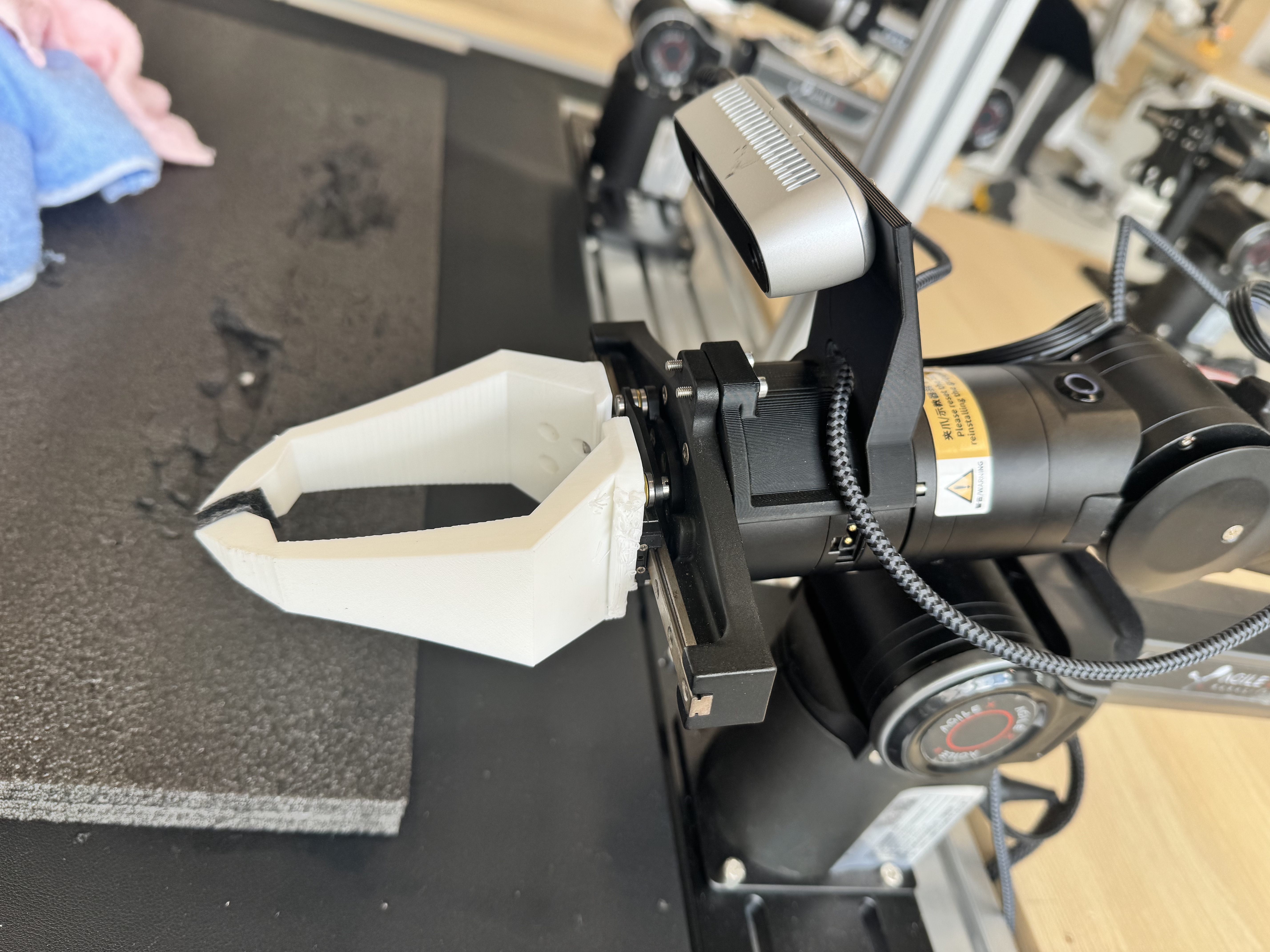
static/images/slim_gripper.jpgThe custom fingers are part of the final hardware configuration. Their contribution was not isolated in a gripper ablation, so no separate performance gain is claimed.
Method
Train base20k for 20k steps on 100 blue-square demonstrations of direct corner grasping.
Run the policy on the robot. Misalignment and near-miss states are reached by the policy rather than scripted in advance.
The operator takes control with two leader arms, recovers the grasp and completes lifting and folding. This yields 101 HIL episodes.
Continue from base20k for 10k HIL steps. Compare against a 20k-step scratch model trained on the same HIL data.
static/videos/pretraining_teleop.mp4static/videos/policy_hil_takeover.mp4Results
Each model is evaluated in 50 trials: ten trials on each of five towels, with the towel position randomized before every run.
| Towel | Training exposure | Base 20k | Scratch 20k | Fine-tuned 10k |
|---|---|---|---|---|
| Blue square | Pretraining | 5 / 10 | 0 / 10 | 8 / 10 |
| Green square | HIL | 3 / 10 | 2 / 10 | 9 / 10 |
| Red square | HIL | 2 / 10 | 3 / 10 | 8 / 10 |
| Yellow square | Unseen | 1 / 10 | 2 / 10 | 6 / 10 |
| White rectangle | Unseen color, instance and shape | 2 / 10 | 3 / 10 | 4 / 10 |
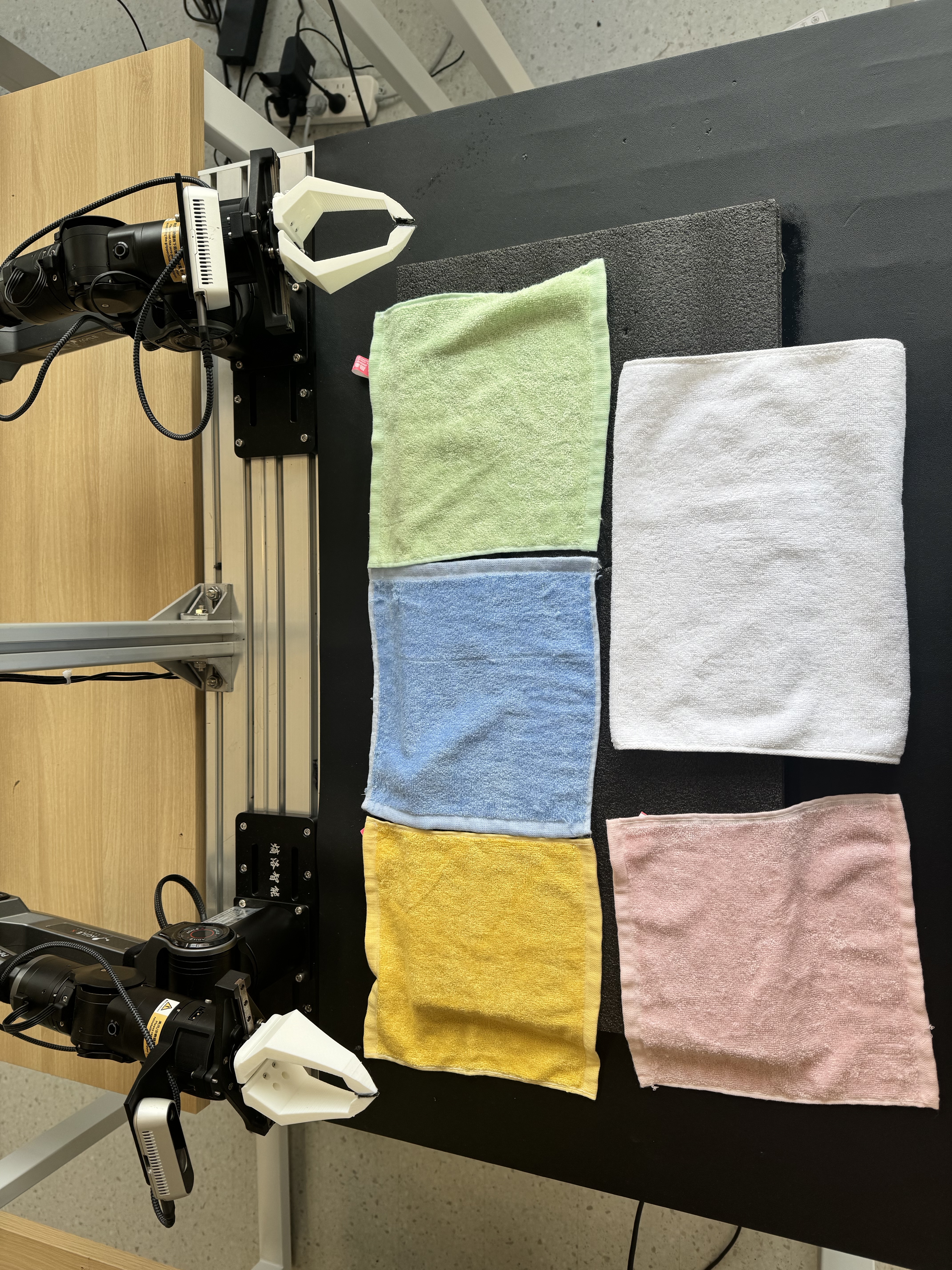
static/images/towel_set.jpgQualitative examples
These complete trials contrast the corner-grasp checkpoint with the fine-tuned full-task policy. The low-performing scratch model remains in the quantitative comparison, but is omitted here to keep the qualitative evidence focused.
static/videos/base20k.mp4static/videos/finetune10k.mp4Scope
Within these limits, the result is clear: preserving the prerequisite corner-grasp skill and fine-tuning on corrective full-task trajectories is substantially more effective than either control used in this study.
Acknowledgements
We thank the Human-Inspired Robotics Learning Lab (HIROL), School of Artificial Intelligence, Shanghai Jiao Tong University, and its team, led by Prof. Wenzhao Lian (连文昭), for their support of this summer research project.
Citation
Xiang Meng and Mingzhe Liu. Bimanual Towel Folding with Corrective Human-in-the-Loop Fine-Tuning. Summer research project website. Advisor: Ning Guo. Project page.